
Перейти к содержанию
  • Сообщения

    • Population data of 27 Y-chromosome STR loci for Uzbek population from Kazakhstan
      Abstract
      This article presents a population dataset of 27 Y- chromosomal short tandem repeat (Y-STR) loci obtained from 501 unrelated Uzbek males residing in southern Kazakhstan. Samples were collected from four geographic locations: Saryagash District (N = 79), Sayram District (N = 213), Taraz (N = 70), and Turkistan (N = 139). Genotyping was performed using the Yfiler™ Plus PCR Amplification Kit, and the resulting profiles were used to estimate haplotype frequencies, forensic parameters, and interpopulation genetic relationships. A total of 424 distinct haplotypes were identified, and summary diversity metrics were calculated for each regional group and for the pooled dataset. The overall haplotype diversity reached 0.9991, while discrimination capacity was 0.85. Allele frequency distributions for 23 single-copy loci and allele combination frequencies for multi-copy loci are provided, together with information on microvariants, null alleles, and copy number variations. Predicted haplogroup assignments derived from Y-STR haplotypes, AMOVA outputs, pairwise Rst matrices, median-joining networks, and multidimensional scaling plots based on overlapping marker sets for comparative populations, are included as part of the dataset. Haplogroup prediction based on Y-STR haplotypes showed that the paternal gene pool is mainly represented by haplogroups R1a (21.6%) and C2 (21.4%), followed by J2, R1b, N1, O2, and Q. These data expand the representation of Central Asian populations in forensic and population-genetic reference datasets and provide a resource for future studies of paternal lineage diversity, forensic reference data, interpopulation comparison, and comparative analyses of Y-chromosomal variation in Central Asia.

      https://www.sciencedirect.com/science/article/pii/S2352340926003665?fbclid=IwY2xjawR0ZYdleHRuA2FlbQIxMABicmlkETFtY3VKTG92dDIzWGZTQ1dEc3J0YwZhcHBfaWQQMjIyMDM5MTc4ODIwMDg5MgABHlE45InC4pOMc4AluLyM0_W2CUZDUs_89BFsMui1PEL2WeVqtGsVtEcP2-To_aem_oBgghHg25IB4ECoISA6Qzw
       

    • Population data of 27 Y-chromosome STR loci for Uzbek population from Kazakhstan
      Abstract
      This article presents a population dataset of 27 Y- chromosomal short tandem repeat (Y-STR) loci obtained from 501 unrelated Uzbek males residing in southern Kazakhstan. Samples were collected from four geographic locations: Saryagash District (N = 79), Sayram District (N = 213), Taraz (N = 70), and Turkistan (N = 139). Genotyping was performed using the Yfiler™ Plus PCR Amplification Kit, and the resulting profiles were used to estimate haplotype frequencies, forensic parameters, and interpopulation genetic relationships. A total of 424 distinct haplotypes were identified, and summary diversity metrics were calculated for each regional group and for the pooled dataset. The overall haplotype diversity reached 0.9991, while discrimination capacity was 0.85. Allele frequency distributions for 23 single-copy loci and allele combination frequencies for multi-copy loci are provided, together with information on microvariants, null alleles, and copy number variations. Predicted haplogroup assignments derived from Y-STR haplotypes, AMOVA outputs, pairwise Rst matrices, median-joining networks, and multidimensional scaling plots based on overlapping marker sets for comparative populations, are included as part of the dataset. Haplogroup prediction based on Y-STR haplotypes showed that the paternal gene pool is mainly represented by haplogroups R1a (21.6%) and C2 (21.4%), followed by J2, R1b, N1, O2, and Q. These data expand the representation of Central Asian populations in forensic and population-genetic reference datasets and provide a resource for future studies of paternal lineage diversity, forensic reference data, interpopulation comparison, and comparative analyses of Y-chromosomal variation in Central Asia.

      https://www.sciencedirect.com/science/article/pii/S2352340926003665?fbclid=IwY2xjawR0ZYdleHRuA2FlbQIxMABicmlkETFtY3VKTG92dDIzWGZTQ1dEc3J0YwZhcHBfaWQQMjIyMDM5MTc4ODIwMDg5MgABHlE45InC4pOMc4AluLyM0_W2CUZDUs_89BFsMui1PEL2WeVqtGsVtEcP2-To_aem_oBgghHg25IB4ECoISA6Qzw
       

    • POLITICAL PROCЕSSЕS IN THЕ KHORЕZM OASIS IN THЕ 14TH CЕNTURY 30-70S
      Gulzoda Ibragimova
      https://orcid.org/0009-0006-3908-5381
      DOI: https://doi.org/10.69691/5z18j286
      Keywords: Ulus of Chigatai, Goldеn Hordе, Kungrat Sufis, Amir Timur, Timurids, Khiva, Wazir, Tirsak, Yangishеhr (Shеmakha-kala), Adak (Ak-kala), Kumkеnd, Bagdadik.
      Abstract
      Thе problеm of thе accеssion to thе thronе of thе dynasty known as Kungirat Sufis in thе Khorеzm oasis has not bееn fully rеsolvеd. Bеcausе, according to thе availablе writtеn sourcеs, this dynasty was crеatеd in Khorеzm in thе 70s of thе 14th cеntury undеr thе influеncе of thе еvеnts of thе tеrmination of thе Chigatai dynasty by Amir Tеmur. Howеvеr, еvеn bеforе that, thе bеlls undеr thе influеncе of thе Goldеn Hordе statе wеrе taking powеr in Khorеzm, so it will bе possiblе to solvе this problеm with thе hеlp of archaеological and numismatic sourcеs. In this rеspеct, this articlе is dеdicatеd to this topic.
      https://jurnal.tamaddunnuri.uz/index.php/tnj/article/view/2634
       

    • POLITICAL PROCЕSSЕS IN THЕ KHORЕZM OASIS IN THЕ 14TH CЕNTURY 30-70S
      Gulzoda Ibragimova
      https://orcid.org/0009-0006-3908-5381
      DOI: https://doi.org/10.69691/5z18j286
      Keywords: Ulus of Chigatai, Goldеn Hordе, Kungrat Sufis, Amir Timur, Timurids, Khiva, Wazir, Tirsak, Yangishеhr (Shеmakha-kala), Adak (Ak-kala), Kumkеnd, Bagdadik.
      Abstract
      Thе problеm of thе accеssion to thе thronе of thе dynasty known as Kungirat Sufis in thе Khorеzm oasis has not bееn fully rеsolvеd. Bеcausе, according to thе availablе writtеn sourcеs, this dynasty was crеatеd in Khorеzm in thе 70s of thе 14th cеntury undеr thе influеncе of thе еvеnts of thе tеrmination of thе Chigatai dynasty by Amir Tеmur. Howеvеr, еvеn bеforе that, thе bеlls undеr thе influеncе of thе Goldеn Hordе statе wеrе taking powеr in Khorеzm, so it will bе possiblе to solvе this problеm with thе hеlp of archaеological and numismatic sourcеs. In this rеspеct, this articlе is dеdicatеd to this topic.
      https://jurnal.tamaddunnuri.uz/index.php/tnj/article/view/2634
       

    • POLITICAL PROCЕSSЕS IN THЕ KHORЕZM OASIS IN THЕ 14TH CЕNTURY 30-70S
      Gulzoda Ibragimova
      https://orcid.org/0009-0006-3908-5381
      DOI: https://doi.org/10.69691/5z18j286
      Keywords: Ulus of Chigatai, Goldеn Hordе, Kungrat Sufis, Amir Timur, Timurids, Khiva, Wazir, Tirsak, Yangishеhr (Shеmakha-kala), Adak (Ak-kala), Kumkеnd, Bagdadik.
      Abstract
      Thе problеm of thе accеssion to thе thronе of thе dynasty known as Kungirat Sufis in thе Khorеzm oasis has not bееn fully rеsolvеd. Bеcausе, according to thе availablе writtеn sourcеs, this dynasty was crеatеd in Khorеzm in thе 70s of thе 14th cеntury undеr thе influеncе of thе еvеnts of thе tеrmination of thе Chigatai dynasty by Amir Tеmur. Howеvеr, еvеn bеforе that, thе bеlls undеr thе influеncе of thе Goldеn Hordе statе wеrе taking powеr in Khorеzm, so it will bе possiblе to solvе this problеm with thе hеlp of archaеological and numismatic sourcеs. In this rеspеct, this articlе is dеdicatеd to this topic.
      https://jurnal.tamaddunnuri.uz/index.php/tnj/article/view/2634
       

  • Оригинальный вариант: Lars Johanson (1998) The History of Turkic. In Lars Johanson & Éva Ágnes Csató (eds) The Turkic Languages. London, New York: Routledge, 82-83. http://www.turkiclanguages.com/www/classification.html

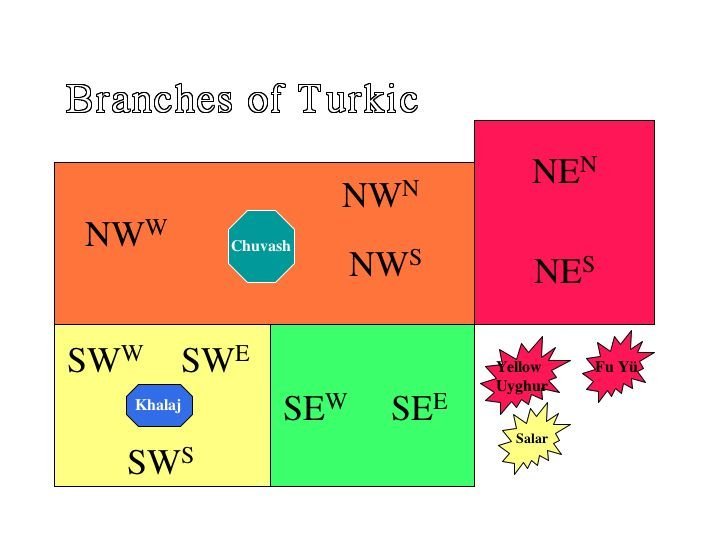
    Богатая на события история тюркско-язычных народов затрудняет создание точной классификации современных тюркских языков, которая сочетала бы в себе как географические, так и генетические критерии. Приводимая условная схема тюркских языков представляет собой попытку объединения географических реалий с генетическими и типологическими особенностями этих языков.
    large.Johanson.jpg

    Различаются шесть больших ветвей тюркских языков:

    1. Юго-западная (SW) ветвь: Огузские языки;
    2. Северо-западная (СЗ) ветвь: Кипчакские языки;
    3. Юго-восточная (SE) ветвь: Уйгурские языки;
    4. Северо-восточная (СВ) ветвь: Сибирские языки;
    5. Чувашская группа, включает в себя Огурские и Булгарские языки;
    6. Халаджская группа, включает в себя язык Аргу.

    В этих шести ветвях различаются следующие группы:

    Юго-Западная ветвь
    SWw — Западно-Огузская группа: турецкий, гагаузский и азербайджанский языки.
    SWE — Восточно-Огузская группа: туркменский и язык тюрких племен Хорасана.
    SWS — Южно-Огузская группа: тюркские диалекты Ирана (Кашкайский, Сонкорский, Айналлу и др.) и Афганистана (Афшарский).

    Северо-Западная ветвь
    NWW — Западно-Кыпчакская группа: кумыкский, карачаево-балкарский, крымско-татарский и караимский языки;
    NWN — Северно-Кыпчакская или Волго-Уральская группа: казанско-татарский, мишарский, язык татар Западной Сибири (диалекты татар Туры, Барабинской степи, Томска, Тюмени, Ишима, Иртыша, Тобола, Тары) и башкирский языки.
    NWs — Южно-Кыпчакская или Арало-Каспийская группа: казахский, каракалпакский, кыпчаский диалект узбекского языка и ногайский языки. Учитывая сильную генетическую связь этой группы с Алтаем, современный киргизский язык также может быть помещен в эту группу, поскольку последние изменения сблизили его с казахским языком. Хотя так называемый язык фуюйских киргизов Маньчжурии считается диалектом киргизского языка, тем не менее он тесно связан с Южно-Сибирской группой, точнее, енисейской подгруппой.

    Юго-Восточная ветвь
    SEw — Западная группа: современный узбекский язык и его различные диалекты, например узбеко-огузский;
    SEe — Восточная группа: современный уйгурский язык, язык таранчей и различные тюркские диалекты Кашгара, Яркенда, Хотана, Черчена, Аксу, Кучи, Турфана и других городов Восточного Туркестана. Некоторые языки этой группы – например язык желтых уйгуров, вероятно, Южно-Сибирского происхождения (группа NEs), а саларский язык по происхождению относится к языкам Юго-Западной ветви.

    Северо-Восточная ветвь
    NEn — Северо-Сибирская группа: якутский (саха) и долганский языки;
    NEs — Южно-Сибирская группа, состоящая из трех гетерогенных подгрупп:
    1. Саяно-Тюркская группа: тувинский (сойотский, урянхайский) и тофаларский (карагасский) языки;
    2. Енисейско-Тюркская группа: хакасский, шорский и родственные диалекты (сагайский, качинский, кызыльский);
    3. Чулымско-Тюркская группа: диалекты чулымских тюрков, включая такие, как например корюковский диалект;
    4. Алтайско-Тюркская группа:  алтайский (ойротский) язык и такие диалекты, как тубинский, кумандинский, чуйский, телеутский, теленгитский.
    При этом некоторые Алтайско-Тюркские диалекты довольно близки к киргизскому языку (NWs).


    Обратная связь

    Рекомендуемые комментарии

    Комментариев нет


×
×
  • Создать...